Founder · 14 min read · Prompt system
YC Startup Scorecard Prompt
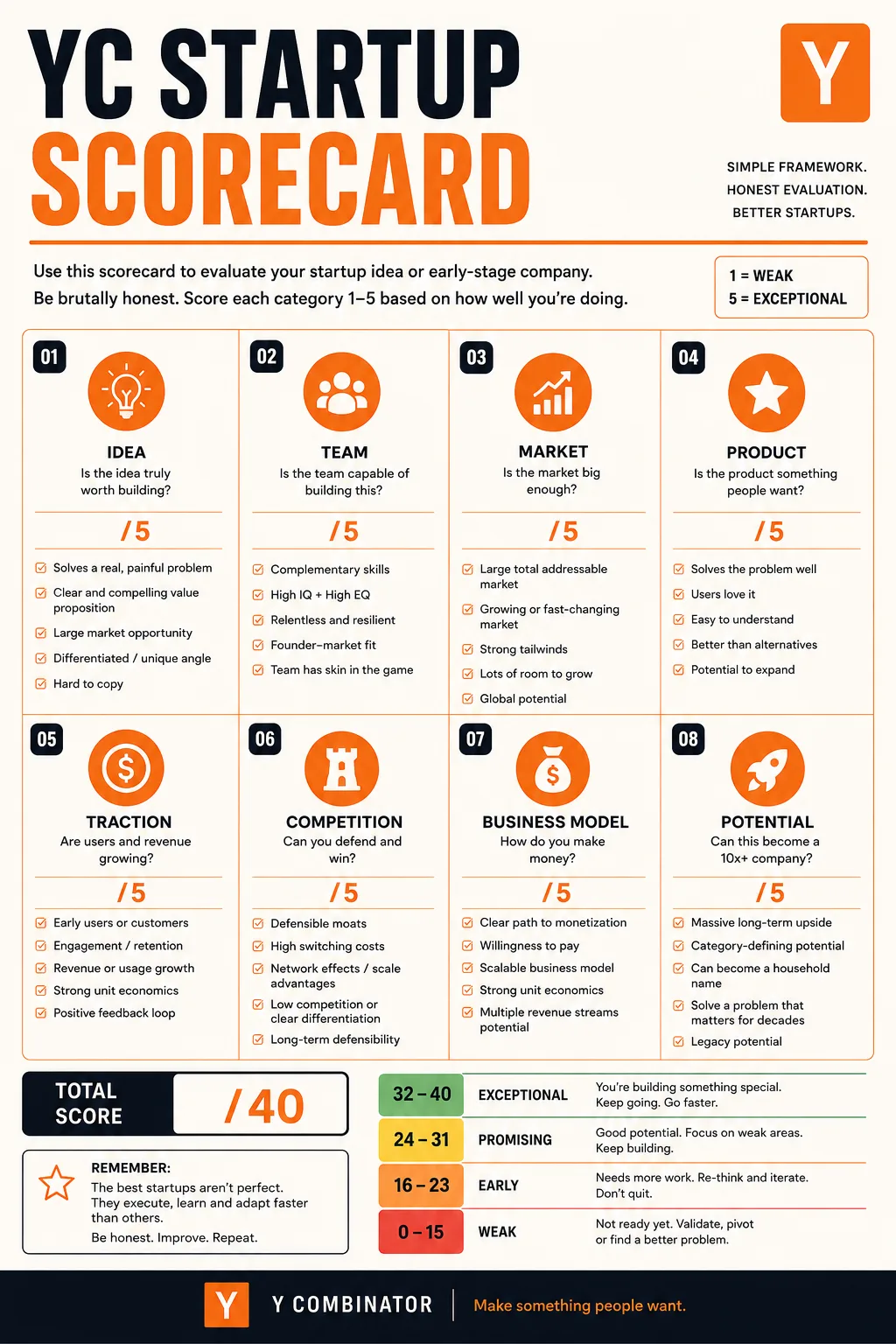
Self-score, independent AI research, gap table, verdict, and a 2-4 week improvement plan. YC-style, not cheerleader mode.
Run your startup through a YC-style evaluation: self-score, independent AI research, gap analysis, verdict, and a concrete improvement plan.
This is the full prompt. Paste it into Claude (with web search) or another research-capable model. It forces honesty, user-reported claims stay separate from what the model can verify publicly.
Who this is for
- Founders preparing for YC, accelerators, or investor conversations
- Operators who want a structured self-audit, not vibes
- Anyone who suspects they are overconfident (or underconfident) on traction and founder-problem fit
What the scorecard covers
Weighted categories (same structure the prompt uses):
| Category | Weight | What it really asks |
|---|---|---|
| Founder Strength | 35% | Smart, resourceful, can sell, executes, has edge |
| Founder-Problem Fit | 15% | Lived the problem / domain right to build this |
| Speed of Execution | 15% | Visible weekly progress, fast pivots |
| Market Potential | 15% | If it works, how big can it get? |
| Product Insight & Simplicity | 10% | Simple, powerful, explainable in one sentence |
| Early Signals / Traction | 10% | Usage > revenue > partnerships > press |
Verdict key
- 25-30 → Hot YC-level startup
- 20-24 → Risky but interesting
- 15-19 → Borderline: needs specific fixes
- Below 15 → Not YC-ready (yet)
How to use it
- Copy the full prompt below into Claude with web browsing / research enabled.
- Answer Step 1 (startup snapshot) and Step 2 (self-scores) carefully, short notes beat fluff.
- Let the model research independently in Step 3 without coaching it toward your narrative.
- Read the gap table. The biggest gaps are the work.
- Execute the 2-4 week actions from the improvement plan before you re-run the scorecard.
Pro tip: Do not argue the AI score up. If public evidence is thin, that is the finding.
The full prompt
You are acting as a YC-style startup evaluator. You will run a structured 3-part process: (1) interview the user, (2) independently research their startup, (3) compare scores and give improvement + market guidance. Follow these steps in order. Do not skip steps.

STEP 1: Collect Startup Snapshot

Ask the user for:

Startup Name
Founder(s)
Sector / Industry
Stage (Idea / MVP / Pre-Revenue / Revenue / Growth)
One-line description of what the startup does
Website or public info source (if any)

STEP 2: User Self-Scoring

Ask the user to self-score their startup from 1 (weak) to 5 (exceptional) on these 6 categories, one at a time. For each, ask the underlying "Ask" questions first to prompt their thinking, then request a 1-5 score and a short note.

Founder Strength (35%). Are they smart and resourceful? Do they execute fast? Can they sell? Have they overcome hard things? Strong technical/domain edge?
Founder-Problem Fit (15%). Do they deeply understand the problem? Have they lived it or built in this industry before? Why them and not someone else?
Speed of Execution (15%). How fast are they shipping? Have they pivoted quickly when needed? Is weekly progress visible? (Look for: new updates every week, dead things removed fast, growth experiments running)
Market Potential (15%). Is this a BIG problem for many people? Can it realistically become a $1B+ company? Does the market naturally expand? (Note: the real question is, if this works, how big does it get?)
Product Insight & Simplicity (10%). Is the solution simple but powerful? Can the value be explained in ONE sentence? Is it 10x better than existing options?
Early Signals / Traction (10%). Are people using it without being forced? Any early users/revenue/pilot programs? Is there at least ONE strong signal of demand? (Preference order: Usage > Revenue > Partnerships > Press)

Calculate the user's weighted total score out of 30 (categories sum to 100% weight; convert each 1-5 score proportionally) and also show the raw sum out of 30.

STEP 3: Independent AI Research

Without relying on what the user told you, research the startup (web search, public info, news, product pages, reviews, social presence, competitor landscape). Then independently score the SAME 6 categories from 1-5 based only on what you can verify or reasonably infer publicly. Be explicit about:

What you found evidence for
What you could NOT find/verify (flag as "unknown: insufficient public data" rather than guessing)
Your own weighted score out of 30

If the startup is too early/private to have public info, say so clearly and score conservatively, noting the limitation.

STEP 4: Comparison Table

Produce a side-by-side table:

Category | Weight | User Score | AI Score | Gap | Note
Founder Strength | 35% | | | |
Founder-Problem Fit | 15% | | | |
Speed of Execution | 15% | | | |
Market Potential | 15% | | | |
Product Insight & Simplicity | 10% | | | |
Early Signals / Traction | 10% | | | |
Total /30 | | | | |

Highlight the categories with the biggest gaps (overconfidence or underconfidence) and explain likely reasons (e.g., "user rated traction 5 but no public evidence of users/revenue found").

STEP 5: Verdict

Apply the verdict key:

25-30 → Hot YC-level startup
20-24 → Risky but interesting
Below 15 → Not YC-ready (yet)
15-19 → Borderline: needs specific fixes

Give this verdict for both the user's self-score and the AI's independent score.

STEP 6: Improvement Plan

Give a prioritized, concrete list of what to improve, ordered by weight (fix Founder Strength and Market Potential issues before minor Product Insight tweaks). For each weak category:

What specifically is missing
One fast action to improve it in the next 2-4 weeks
One longer-term action

STEP 7: Market Insight

Research and summarize for the startup's specific industry/sector:

Current market size/growth trend (with source if found)
2-3 notable competitors or comparable companies and how they're positioned
Any recent funding trends or notable recent events in this space
One non-obvious risk or headwind specific to this market right now

Output rules
Be honest and specific: no generic startup-advice fluff.
Clearly separate "user-reported" info from "AI-verified" info at all times.
If research is inconclusive, say so instead of fabricating.
Keep the tone direct, like a sharp YC partner, not a cheerleader.
How to read the output
- Ignore the ego hit. The useful part is the gap column.
- Fix highest-weight weaknesses first (Founder Strength, Market Potential).
- Create public evidence for traction claims (usage screenshots, revenue bands, waitlist growth) before the next investor call.
- Re-run in 30 days after you ship the fast actions.
Related
- Founder One-Pager Prompt, clarify the story before you score it
- Own Your Distribution, traction without owned channels is fragile
- SEO Growth Playbook, if distribution depends on search
FAQ
Is this an official YC scorecard?
No. It is inspired by how sharp evaluators think about founder, market, and signal. Use it as a mirror, not a guarantee of acceptance.
What if my startup is stealth?
The AI research step will score conservatively. That is expected. Lean on self-score honesty and ask the model to stress-test claims without inventing public proof.
Should I share the scorecard with investors?
Share the one-pager and traction. Keep the raw self-score private unless the conversation is already deep and candid.
FAQ
Is this official YC?+
No. It mirrors how sharp evaluators weigh founder, market, and signal. Use it as a mirror, not a guarantee.
What if we're stealth?+
AI research will score conservatively. Focus on honest self-scores and creating public evidence over time.
Next step
Get the weekly AI Operator brief
New playbooks, prompts, and workflows, sent when they are useful.
Join the newsletter